

- DC Ceiling Fan
✅ Advantages
More energy-efficient
The DC motor has high efficiency and typically consumes 30%–60% less electricity than AC ceiling fans. This results in lower electricity bills over the long term.
Quieter operation
The DC motor has a precise structure, generates little vibration, and has low noise, making it suitable for quiet spaces such as bedrooms and study rooms.
More precise speed control
Most DC ceiling fans come with more gears (6–9), allowing for fine wind speed adjustment and providing a higher level of comfort.
Lower motor heat generation, longer lifespan
Less heat generation, fewer internal part wear and tear, and better durability under normal voltage conditions.
Multi-functional integration
Most DC ceiling fans support intelligent functions such as remote control, timer, and reverse rotation.
❌ Disadvantages
High price
The DC motor and control board have high costs, and the initial purchase price is usually higher than that of AC fans.
High maintenance cost
The electronic control board is more complex. If it is damaged, the cost of repair or replacement is higher.
High requirement for voltage stability
In areas with unstable voltage or frequent lightning, the control board is more likely to be damaged.
二. AC Ceiling Fan
✅ Advantages
Simple structure, highly durable
The AC motor technology is mature, the structure is sturdy, and it is more durable in harsh environments.
Easy to maintain, low cost
The components have high compatibility, making maintenance simple and suitable for long-term high-intensity use.
Affordable price
Low purchase cost, high cost-effectiveness, suitable for large-scale installations (such as dormitories, factories).
Strong adaptability to voltage fluctuations
It can still operate stably in areas with unstable voltage and has high reliability.
❌ Disadvantages
High power consumption
The energy efficiency is lower than that of DC motors, resulting in higher electricity bills over the long term.
Relatively loud noise
The motor and mechanical friction sounds are more noticeable during operation.
Few speed adjustment levels
Usually, only 3-5 levels are available, and the wind speed adjustment is not fine enough.
High motor heat generation
Long-term use may accelerate the aging of bearings and coils, and the lifespan is affected by the usage environment.
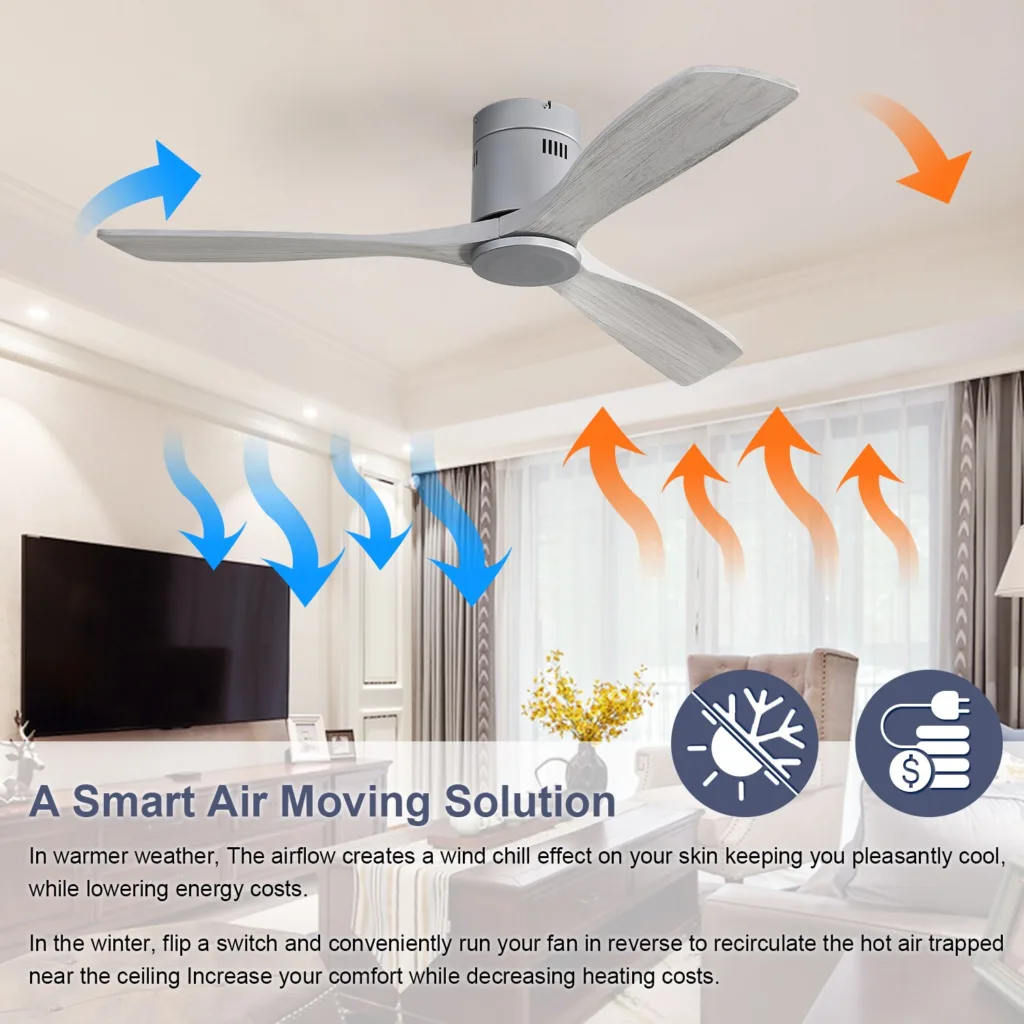
📌 overall durability assessment
✅ AC Ceiling Fan (AC Motor) – More Durable
The motor structure is simpler: The design of the AC motor is mature, without complex electronic components, and is less prone to damage.
Stronger resistance to voltage fluctuations: In environments with unstable voltage (such as factories, dormitory buildings, and old wiring), it can operate more stably.
Lower maintenance cost: Common parts, convenient maintenance, and easier long-term maintenance.
Suitable for long-term high-intensity use, such as commercial spaces or all-day fan operation mode.
👉 Conclusion: If you value “long-lasting durability and low failure rate” the most, AC ceiling fans perform more stably in many practical usage scenarios.
✅ DC Ceiling Fan (Direct Current Motor) – Good durability, but dependent on electronics
The motor itself operates at a low temperature and has minimal wear: with normal voltage conditions and proper maintenance, the lifespan of a DC motor is also quite long.
However, the electronic part of the control board is more fragile: it has more circuit boards and chips, and these components are more sensitive to lightning strikes and voltage spikes.
Dependence on stable voltage: Without a voltage stabilizing device, in areas with large voltage fluctuations, the risk of control board failure is higher.
👉 Conclusion: DC ceiling fans also have good durability in household environments, but in scenarios with unstable power conditions or high-intensity usage, their durability is slightly inferior to that of AC ceiling fans.
| Durability factors | AC Ceiling Fan | DC Ceiling Fan |
|---|---|---|
| Motor robustness | ⭐⭐⭐⭐⭐ | ⭐⭐⭐⭐ |
| Control panel durability | ⭐⭐⭐⭐⭐(No control board) | ⭐⭐⭐ |
| Adaptability to voltage fluctuations | ⭐⭐⭐⭐⭐ | ⭐⭐⭐ |
| Difficulty level of repair | ⭐⭐⭐⭐⭐ | ⭐⭐⭐ |
| Prolonged high-intensity use | ⭐⭐⭐⭐⭐ | ⭐⭐⭐⭐ |