

When selecting a modern ceiling fan, you may notice significant differences in price tags. The core of this disparity often lies in the internal drive motor: is it a traditional Alternating Current (AC) motor or an advanced Direct Current (DC) motor?
With the advent of 2026 home energy efficiency standards and the growing prevalence of smart home technology, DC motors have emerged as the preferred choice for high-end residences.
This article will analyze—from four key dimensions: energy efficiency, quiet operation, control precision, and long-term costs—why a DC motor represents the smarter investment.
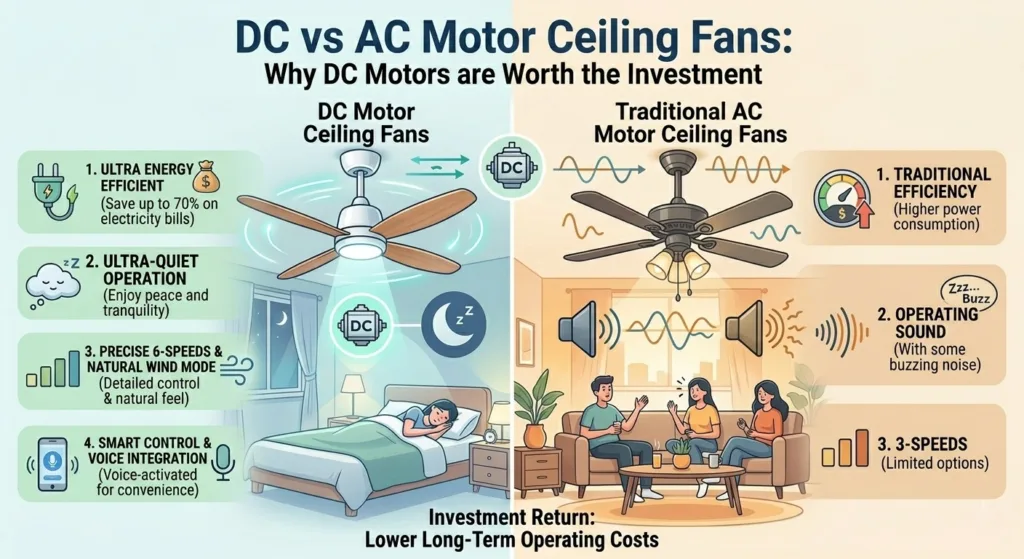
- Superior Energy Efficiency: Save Up to 70% on Power
The most fundamental advantage of DC motor ceiling fans is their astonishing energy efficiency ratio.
DC Motors: Utilize permanent magnets to generate torque, thereby minimizing electrical energy loss.
AC Motors: Rely on electric currents flowing through copper coils to create an electromagnetic field; this process generates significant heat during operation, resulting in substantial energy loss.
Return on Investment: In the long run, DC motor ceiling fans consume only about one-third of the electricity required by traditional AC fans. In today’s climate of rising electricity rates, this investment typically pays for itself within 2 to 3 years through the savings on utility bills.
- Ultimate Quietness: The Ideal Companion for Bedrooms
If you are sensitive to noise, a DC motor is your only choice.
Because DC motors generate less internal friction and offer smoother speed transitions, they operate almost entirely without the characteristic “humming” sound often associated with AC motors.
When running at low speeds, you may not even sense the fan’s presence—making it perfectly suited for bedrooms and nurseries.
- 6 Speed Settings and Precise Control
Traditional AC ceiling fans typically offer only three speed settings (High, Medium, and Low), whereas DC motor ceiling fans come standard with 6—or even more—adjustable speed settings.
Natural Breeze Mode: DC motors can execute subtle variations in rotational speed, simulating the natural, fluctuating gusts of an outdoor breeze.
Instant Start/Stop: DC motors offer extremely rapid response times, reaching the designated speed the very instant they are activated.
- Built-in Reversible Direction: Versatile for All Seasons
Most DC motor ceiling fans feature a one-touch reverse function controllable via remote control.
Summer Mode: Forward rotation generates a powerful downward airflow, providing rapid cooling relief.
Winter Mode: Reversing the rotation pushes warm air accumulated near the ceiling down along the walls and circulates it toward the floor.
In contrast, many AC fans require you to manually flip a physical switch on the motor—a highly inconvenient process.
- Lighter, Smarter Design
DC motors are more compact and lightweight.
This gives designers greater creative freedom to craft ultra-slim, minimalist aesthetics that align perfectly with the minimalist design trends of 2026.
Furthermore, DC motors make it easier to integrate smart chips (such as those supporting the Matter protocol), enabling seamless control via mobile apps or voice commands.
Conclusion: Which One Is the Better Buy?
Although the initial purchase price of a DC ceiling fan is typically 30% to 50% higher than that of an AC model, when you factor in the extremely low operating costs, improved sleep quality, and year-round utility, it is undoubtedly a worthwhile long-term investment in enhancing your quality of life.