

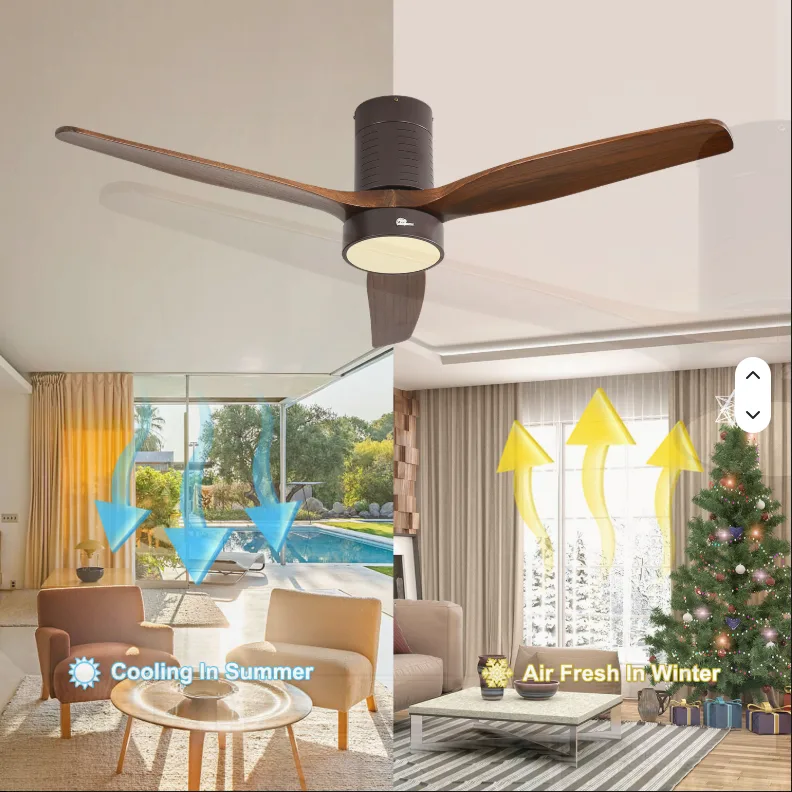
When selecting a ceiling fan light, many customers first look at the appearance and size, but for project procurement, size, airflow, and the installation environment must all be considered together.
1. Determine the Size Based on the Room Area
The reference ranges provided by ENERGY STAR can serve as a preliminary basis for selection:
Room Area Recommended Fan Size
≤75 ft² 29–36″
76–144 ft² 36–42″
144–225 ft² 44″
225–400 ft² 50–54″
Please note that these are reference ranges, not fixed standards. Actual project requirements may need to be adjusted based on the space layout, ceiling height, and intended usage area.
2. Don’t Just Look at Fan Size—Consider CFM as Well
CFM (Cubic Feet per Minute) is a key parameter for measuring a fan’s airflow.
Even among 52-inch fans, actual airflow can vary significantly depending on the motor, blade design, and rotational speed.
Therefore, when comparing products from different suppliers, it is recommended to verify the following:
Fan Size: 42“ / 48” / 52“ / 56”
CFM: Low Speed / Medium Speed / High Speed
Motor Power: Power Rating
RPM: Rotational Speed
Noise: Noise Level
If you only compare “52-inch” fans while ignoring these parameters, you may easily end up with fans of the same size but with significantly different performance in actual use.
3. Installation Height Is Equally Important
Even if the fan size is appropriate, it does not guarantee ideal performance after installation.
ENERGY STAR recommends that, for standard ceiling fans, the blades be installed at least approximately 7 ft above the floor; for spaces with lower ceilings, consider **Flush Mount** products.
Therefore, when submitting a project inquiry, in addition to providing the room area, it is also recommended to specify:
Ceiling Height + Mounting Type + Fan Size
4. Selection Criteria Vary by Project Type
Bedrooms: Focus more on comfort, noise levels, and lighting.
Living Rooms: Balance airflow, size, and overall spatial proportions.
Hotels/Commercial Projects: In addition to airflow, consider installation methods, control features, certifications, and batch consistency.
Outdoor Projects: It is also necessary to confirm whether the product is suitable for the corresponding humid or outdoor environment.
Conclusion
Selecting a fan light is not simply a matter of looking at “how many inches.”
For projects and bulk purchases, it is recommended to follow this sequence:
Space Area → Fan Size → CFM → Power → Installation Height → Operating Environment
Verify each item one by one.
Clarifying these parameters in advance can reduce selection issues that arise during sample testing and bulk procurement, and it also makes it easier for suppliers to provide more suitable product solutions based on the actual project.