

When you think of ceiling fans, most people immediately think of them as “summer essentials.” But did you know that today’s high-quality ceiling fans not only bring coolness in the sweltering summer but also play a significant role in the cold winter?
All thanks to the “reverse” function of ceiling fans.
Today, we’ll delve into the amazing effects of reverse-rotation ceiling fans, their advantages and disadvantages, and help you understand why they’ve become a “year-round must-have” for modern homes!
I. What is Reverse Rotation in Ceiling Fans? What Does It Do?
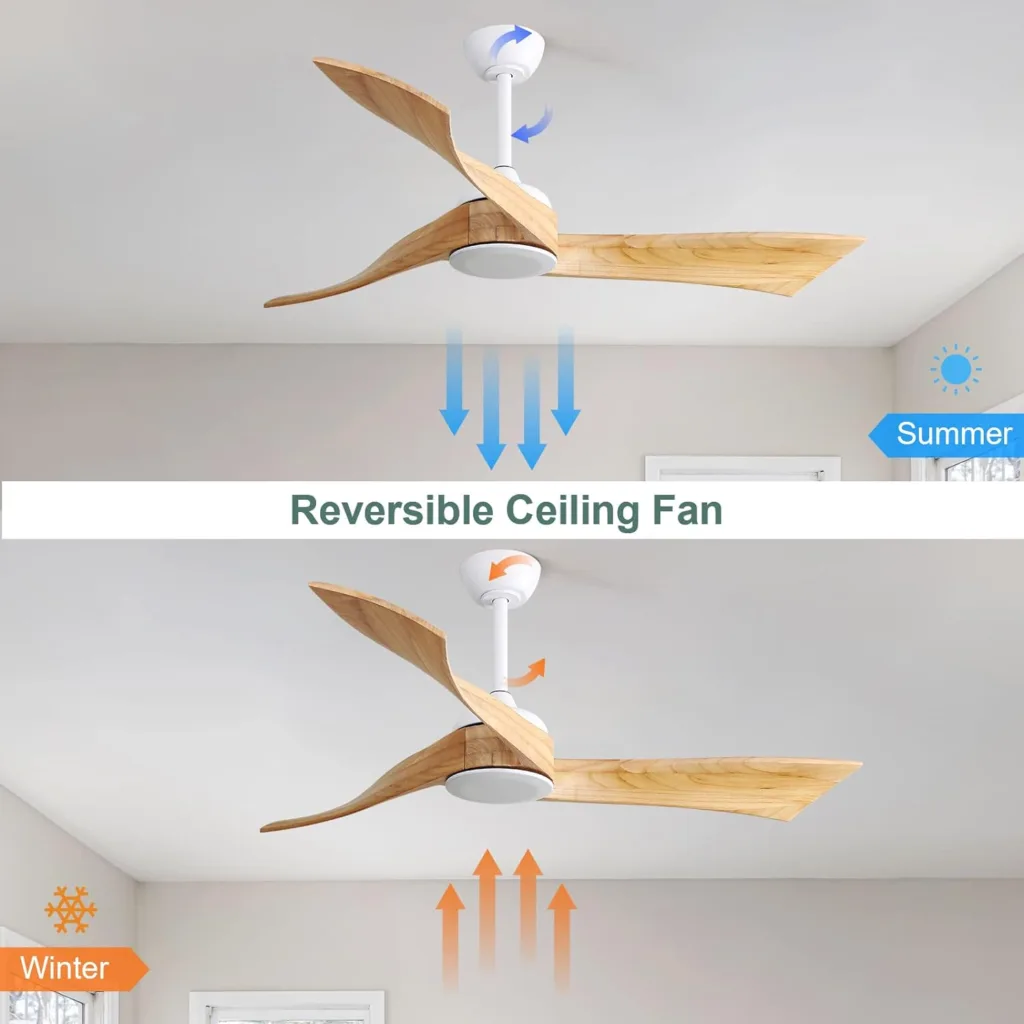
Most ceiling fans with forward and reverse rotation functions can switch the direction of the fan blades with a single button on the remote control or the motor. Its core function is to change the direction of airflow to suit different seasonal needs:
❄️ Summer Mode (Forward/Counter-clockwise Rotation):
The fan blades push the air downwards, creating a direct “Wind Chill Effect.” This not only makes people feel cool but also, when used with air conditioning, allows cool air to be quickly and evenly distributed throughout the room.
🔥 Winter Mode (Reverse/Clockwise Rotation):
This is where the “reverse” function comes in! In winter, warm air is lighter and tends to accumulate at the top of the ceiling, while cool air sinks to the ground. When the ceiling fan reverses its rotation, the blades create an upward airflow that draws the cool air from the bottom up, while simultaneously “squeezing” the warm air from the ceiling back down the walls to the floor.
Result: It recirculates warm air in the room without blowing cold air directly, keeping every corner of the room warm and cozy!
II. Advantages of Reversible Ceiling Fans
Key Selling Points:
- Significantly Reduces Energy and Electricity Costs 💰 Turning on the reverse mode of a ceiling fan in winter maximizes the efficiency of heating systems (such as radiators, air conditioners, and fireplaces). Because heat is effectively circulated, you can lower the thermostat temperature by a few degrees without feeling cold. Statistics show that using a reverse ceiling fan can save up to 15% on winter heating costs.
- Suitable for All Seasons, Excellent Value 🔄 Traditional fans become dusty in autumn, while ceiling fans with reversible functions are year-round home helpers. For the price of one, you get an appliance that improves comfort in all seasons, greatly increasing product utilization.
- Enhances Indoor Comfort, Say Goodbye to “Hot and Cold” Conditions 🌡️ When using heating in winter, it’s common to experience a “hot head, cold feet” phenomenon. Reversible ceiling fans balance the temperature throughout the room, eliminating “cold spots” and “hot spots,” making the environment more comfortable and natural.
- Improves Air Circulation, Prevents Moisture and Mold 🌬️ Besides regulating temperature, the reverse mode can also promote indoor air circulation without blowing directly on people. For rooms prone to dampness (such as basements or during the hot, humid rainy season), turning on the reverse mode can accelerate air circulation, keep the room dry, and reduce mold growth.
III. Disadvantages and Precautions of Reverse Ceiling Fans
- Does not have a “heating” function.
Disadvantage: Reverse ceiling fans are merely heat carriers; they cannot generate heat themselves. If there is no heating or heat source in the room, turning on the reverse mode in winter will be ineffective.
【Seller’s Tip】: It is recommended that customers use it in conjunction with heating, fireplaces, or underfloor heating for the best results!
- Clean the fan blades before switching.
Disadvantage: If the ceiling fan has been running in the forward direction all summer, dust can easily accumulate on the top of the blades. Suddenly turning on the reverse mode in winter (the airflow hits the ceiling and then disperses) may cause dust to fall like snowflakes.
【Seller’s Tip】: Before switching between forward and reverse modes for the season, be sure to remind customers to clean the fan blades with a cloth!
- Limited effect on extremely high ceilings.
Disadvantage: For duplex or villa living rooms with very high ceilings (e.g., over 3.5 meters/12 feet), the warm air circulation effect of a reverse-rotation ceiling fan will be weakened due to the distance.
[Seller’s Tip]: For this situation, we recommend purchasing our downrods accessory, which perfectly solves the height problem!
Summary: Is it worth buying?
Whether you want to enjoy cool breezes in the summer or save on expensive heating bills in the winter, a high-quality ceiling fan with forward and reverse rotation is a wise investment for every modern family.