

The power consumption of ceiling fans is largely determined by the type of motor. Currently, there are three main types on the market: AC motors, DC brushless motors, and the less common EC motors (high-efficiency DC inverters).
The following explains their energy consumption differences in detail.
I. AC Motor (Traditional Type)
🔹 Working Principle
Driven directly by 220V AC power, rotation is achieved through electromagnetic induction.
🔹 Power Range
Typically 60–100W
🔹 Features
Simple structure
Low cost
Mature technology
Relatively high noise
Speed adjustment (3/5 speeds)
🔹 Energy Consumption
Low efficiency (approximately 60%–75%)
Significant power consumption at high speeds
High electricity costs due to prolonged use
📌 Example
8 hours overnight:
75W × 8 hours = 0.6 kWh
Approximately 18 kWh per month in summer
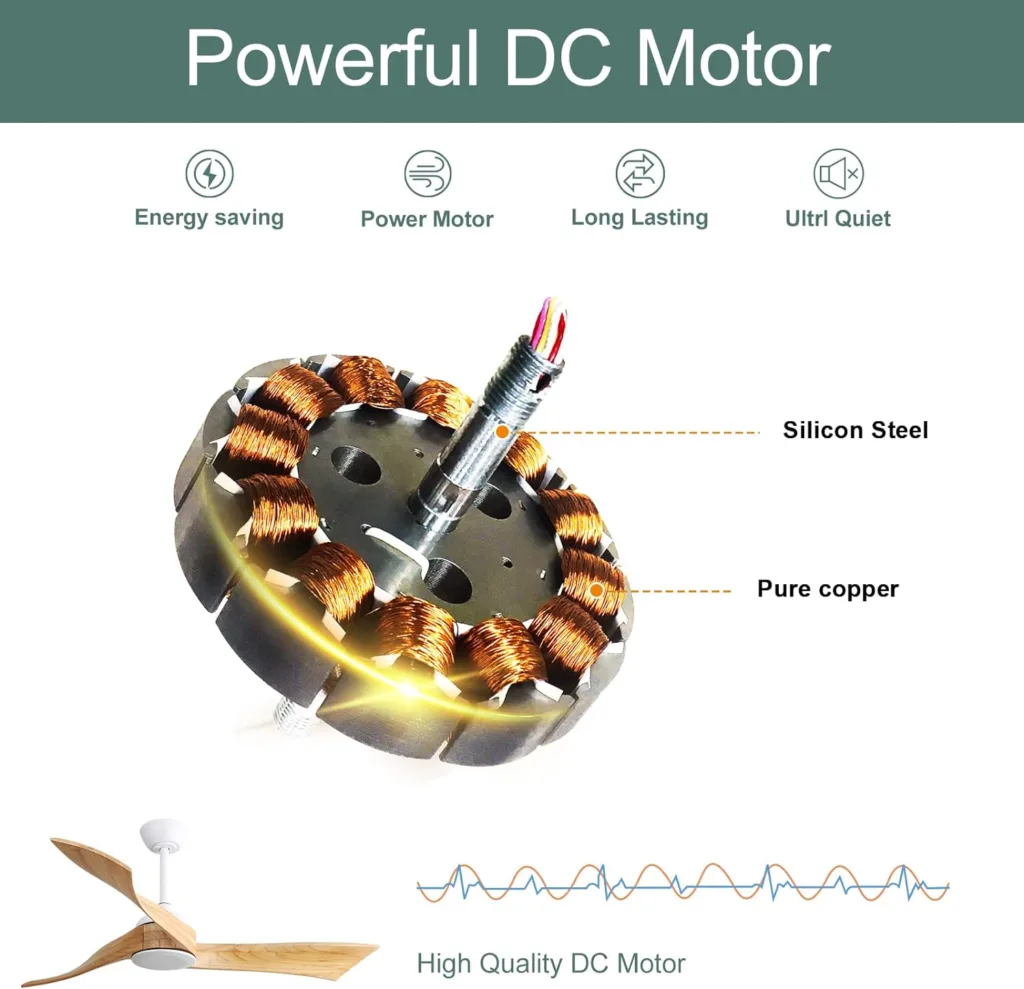
II. DC Brushless Motor (Mainstream Energy-Saving Model)
🔹 Working Principle
AC power is converted to DC power through rectification, and the controller precisely adjusts the speed to drive the brushless motor.
🔹 Power Range
Typically 20–35W (same airflow)
🔹 Features
Energy saving up to 40%–70% of AC
Lower noise
Stepless speed control (1–6 speeds or more)
Smooth start-up
Can rotate in both directions (winter recirculation)
🔹 Energy Consumption
Efficiency up to 85%–90%
Extremely low power consumption at low speeds (possibly around 10W)
📌 Example
Running for 8 hours:
30W × 8 hours = 0.24 kWh
Approximately 7 kWh per month
👉 Significant savings on electricity bills over a year
III. EC Motor (High-end)
EC = Electronically Commutated Motor. Essentially, an upgraded version of a DC brushless motor, commonly found in commercial ventilation equipment.
🔹 Power
Usually lower and more stable
🔹 Features
Ultra-high efficiency
Precise speed control
Strong stability
High cost
Household ceiling fans rarely explicitly label themselves as EC; most DC fans are already very efficient.
Energy Consumption Comparison Summary
| Motor type | power | Energy efficiency | noise | price | Recommendation Index |
|---|---|---|---|---|---|
| AC | 60–100W | ⭐⭐ | medium | Low | General |
| DC | 20–35W | ⭐⭐⭐⭐ | Very low | Medium and high | ✅Most recommended |
| EC | 15–30W | ⭐⭐⭐⭐⭐ | Extremely low | high | high-end |
Why is DC more energy-efficient?
No brush friction loss
Precise speed control, no energy waste
Low starting current
Power automatically decreases at low speeds
AC motors:
Still consumes higher current at low speeds
Speed control relies on voltage reduction, resulting in low efficiency
Practical Usage Recommendations
If you:
Use it for more than 4 hours a day
Use it for more than 4 months in summer
High electricity price per unit
👉 Choose DC; you can basically recoup your investment in 1-2 years
If:
Use it occasionally
Limited budget
Just for auxiliary air conditioning
👉 AC is also sufficient