

In modern home design, an increasing number of apartments and contemporary residences feature single-level layouts, typically with ceiling heights ranging from 2.4 to 2.6 meters (8 to 9 feet).
For such spaces, opting for a traditional ceiling fan with a long downrod not only makes the room feel cramped and oppressive but may also pose potential safety hazards.
How can you enjoy the quiet, cooling comfort of a DC motor without sacrificing a sense of spaciousness? This Ultimate 2026 Buying Guide will teach you how to select the perfect modern LED ceiling fan for homes with low ceiling heights.
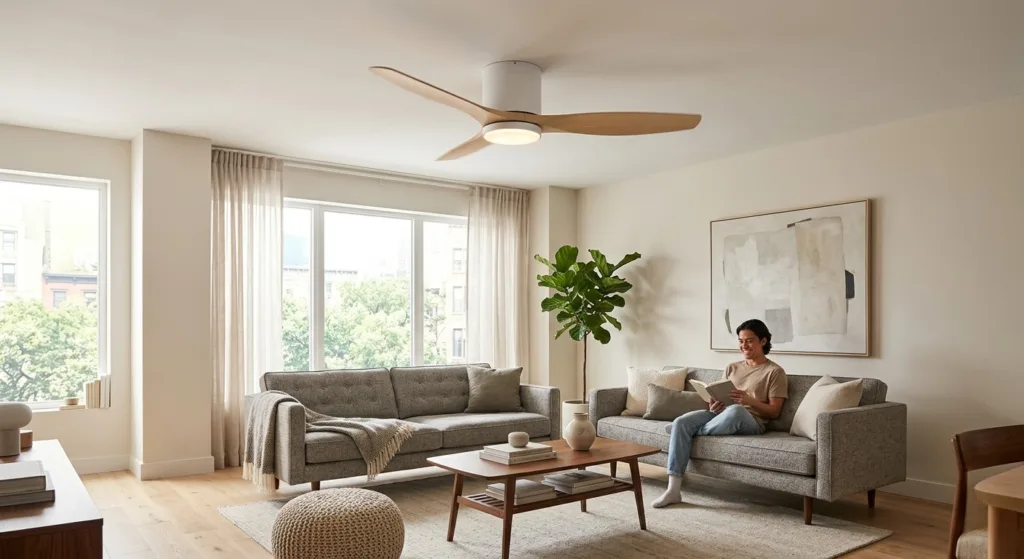
- Prioritize “Flush Mount” Designs (Hugger Fans)
For rooms with low ceilings, a flush-mount ceiling fan (also known as a “hugger” fan) is the only correct choice.
What is a flush mount? This type of fan eliminates the long downrod, mounting the motor housing directly onto the ceiling base.
Spatial Advantage: This design keeps the fan blades as close to the ceiling as possible, leaving more clearance and headroom below (it is recommended that the fan blades be positioned at least 2.1 meters above the floor). - DC Motors: Compact Size, Powerful Airflow
Homes with low ceilings are often more sensitive to noise. The mainstream choice for 2026 is the variable-speed DC motor.
Ultra-Slim Design: DC motors are lighter and more compact than traditional AC motors, allowing for thinner fan profiles that sit closer and more flush against the ceiling.
Whisper-Quiet Operation: Even in low-ceiling spaces, you won’t hear the motor humming—making them ideal for bedrooms and home offices. - Blade Shape and Material: Visual Lightness
In small or low-ceiling spaces, a sense of visual “lightness” is paramount.
Minimalist Three-Blade Design: Compared to five-blade fans, a three-blade design features cleaner lines and prevents the ceiling area from looking cluttered or heavy.
Light or Natural Wood Tones: Choosing blades that closely match your ceiling color (such as white or light oak) creates a visually “seamless” or “invisible” effect, helping to visually heighten the ceiling and expand the sense of space. 4. Integrated LED Lighting: More Than Just a Fan—It’s the Main Light Source
Rooms with low ceiling heights are often ill-suited for the installation of bulky, heavy pendant lights.
Ultra-Slim LED Panels: Opt for ceiling fans featuring an integrated LED light source; typically only a few centimeters thick, these units seamlessly combine lighting and ventilation into a single fixture.
Tri-Color Lighting: The 2026 fan models typically support switching between three light modes—warm yellow (for ambiance), natural light (for daily use), and cool white (for work/study)—to meet the diverse functional needs of small spaces. - Size & Proportion: Better Too Small Than Too Big
In spaces with low ceilings, size selection requires extra caution:
Under 10 m² (e.g., study/walk-in closet): A size of 36–42 inches is recommended.
10–20 m² (e.g., secondary bedroom/small living room): 48–52 inches represents the ideal proportion.
Tip: Ensure that the tips of the fan blades are at least 45 cm away from the nearest wall or cabinet to guarantee smooth airflow. - Safety First: The Benefits of Reversible Functionality
In rooms with low ceilings, warm air tends to stagnate near the ceiling.
Summer Mode (Forward Rotation): Provides a gentle, downward breeze.
Winter Mode (Reverse Rotation): A standard feature on 2026 DC motor models, this function gently pushes the warm air accumulated near the ceiling back down into the room without creating a direct, cold draft—an extremely effective method for temperature control in homes with low ceilings. - Smart Controls: Say Goodbye to Pull Chains
Since the fan hangs relatively close to the occupants in low-ceiling spaces, traditional pull-chain switches are not only aesthetically unappealing but also inconvenient to use.
Remote/App Control: Modern ceiling fans come standard with a remote control and often support smartphone apps or smart voice assistants (such as those utilizing the Matter protocol), allowing you to precisely adjust the fan speed (across 1–6 settings) right from the comfort of your bed or sofa.
Conclusion
When selecting a ceiling fan for a home with low ceilings, the core priorities are “lightweight, slim, and quiet.” A low-profile LED ceiling fan equipped with a reversible DC motor not only eliminates the oppressive feeling often associated with low ceilings but also leverages technology to enhance the overall comfort and quality of your living environment.