

Below is the installation guide for the “Five-blade ABS ceiling fan” – that is, a ceiling fan with blades made of ABS plastic and usually five blades – along with its main features – advantages/disadvantages.
Why choose an ABS + five-blade ceiling fan
Lightweight/yet strong: ABS is a thermoplastic with excellent toughness and impact resistance, and is not prone to cracking or deformation. ABS fan blades are usually much lighter than wooden or metal ones, which reduces the burden on the motor and hanging brackets and is conducive to long-term stable operation.
Moisture-resistant/easy to maintain: Compared with wooden leaves that are prone to moisture, swelling, or deformation, ABS leaves are less sensitive to moisture and environmental changes and are also easier to clean – just wipe them with a dry cloth. There is no need for regular maintenance or oiling like wooden leaves.
The wind force and air flow distribution are more uniform: The five-blade design is more common in ceiling fans. Five blades can generate a stable and uniform air flow at relatively low rotational speeds, making it suitable for general home environments.
Diverse styles + high cost performance: Due to the low cost and easy shaping of ABS, manufacturers can produce various shapes and colors, suitable for modern minimalist – ordinary home style needs.
Potential disadvantages
Compared with wood leaves, it may lack the “natural wood feel” and decorative effect.
If installed improperly or not supported firmly enough, the ceiling fan may vibrate or shake when in operation.
Installation Guide (Applicable to Most Five-blade ABS Ceiling Fans – Based on Common Instructions)
The following are general steps for your reference only. For actual installation, please refer to the manual attached to the specific product. It is recommended that it be operated by a qualified electrician or an experienced person.
Prepare the hanger/support structure
Ceiling fans must be installed on a solid ceiling (wooden or concrete structure) and cannot be hung only on lightweight gypsum boards/thin plates.
Make sure that the hanger/connection box can bear weight (usually at least 50-60 kg).
Mounting Bracket
Fix the hanger to the ceiling structure with screws/expansion bolts, and try to avoid direct contact with the wire outlet holes.
If it is a concrete ceiling, it needs to be pre-drilled and fixed with expansion bolts. If it is a wooden board, use wood screws.
Assemble the Downrod and Canopy/Hanger Ball
Pass the power cord and (if any) the wire of the ceiling fan lamp through the hanging pipe, and then install the hanging pipe, the wall clock, and the decorative cover in sequence.
Insert the hanging pipe and lock the fixing pin/clamp (such as R-clip, locating pin, etc.) firmly to ensure that the hanging pipe is firmly connected to the motor.
Install the fan blades
Align each ABS blade with the screw holes of the motor blade disk/blade frame and lock them with the matching screws and flat washers.
It is recommended to confirm that each blade has the same weight before installation, which helps maintain balance and reduces vibration during operation.
A truly green solution
Hang up the main body of the ceiling fan
Insert the hanging ball into the mounting bracket and gently rotate it until the positioning mechanism gets stuck – the ceiling fan should not be able to rotate freely left and right.
Make sure that the safety steel cables/anti-fall devices/hanger screws are all fixed.
Electrical wiring
When the power is off, connect the power cord (live wire, neutral wire, ground wire). If the ceiling fan is equipped with a light, also connect the wires of the lamp.
Use appropriate circuit breakers/fuses and comply with local electrical regulations.
Inspect + level + fix the decoration
Make sure all screws are tightened, the blades are balanced, there is no shaking, and the ceiling fan is firmly connected to the ceiling.
A truly green solution
If the ceiling fan is equipped with a light, install the lamp and the lampshade/lampshade cover.
Power-on test
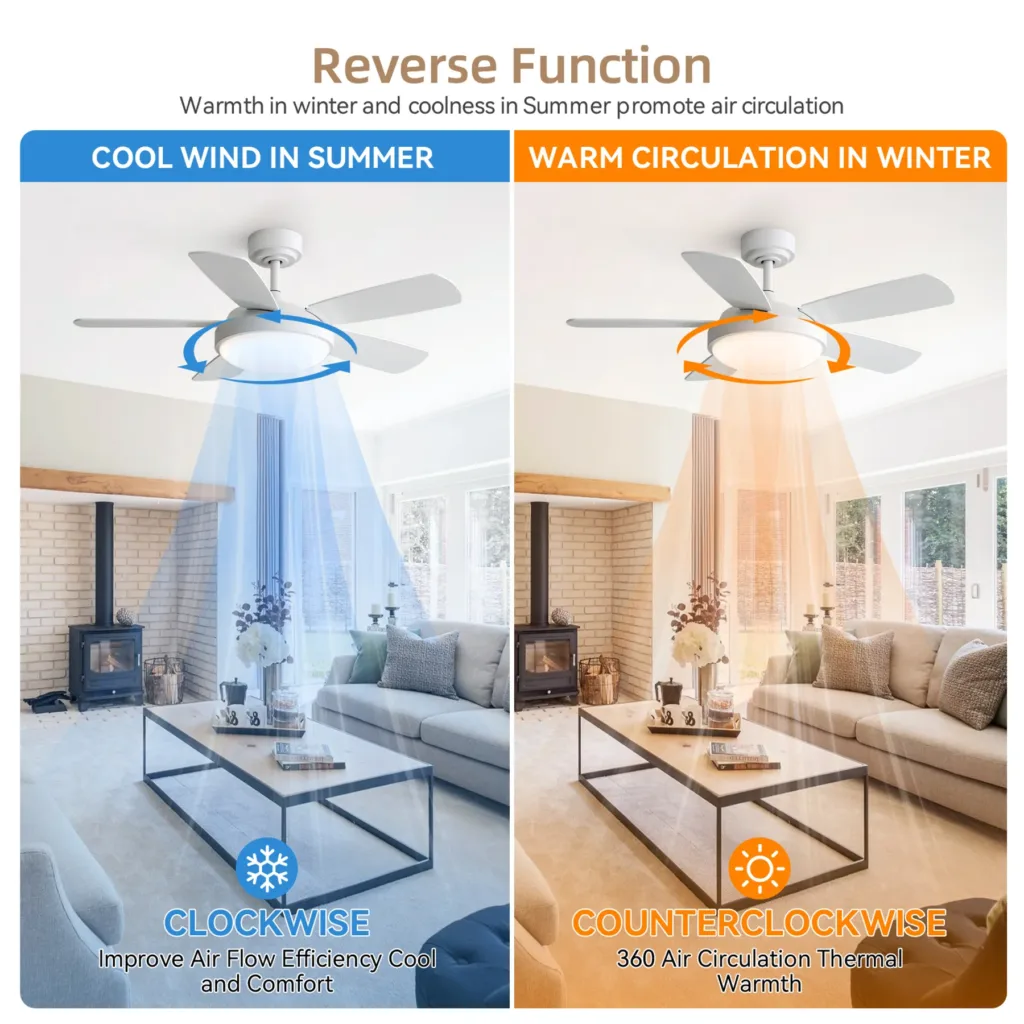
After installation is completed, reconnect the power supply and test whether the ceiling fan’s various speeds, forward and reverse rotations, and lights (if any) are operating normally.
⚠️ Safety reminder:
Ceiling fans must be hung on ceiling junction boxes or structural beams that are “suitable for ceiling fan support”. The original light box cannot be replaced alone; otherwise, it may fall due to insufficient load-bearing capacity.
The installation height must be safe – the end of the fan blade should be at least 2.3 meters (≈ 7.5 feet) above the ground.
If you are not familiar with electrical operations, it is recommended that you ask a qualified electrician to install it on your behalf.
If you are looking for a ceiling fan that is lightweight, easy to install, simple to maintain, and suitable for general home environments, choosing a five-blade + ABS blade is a great compromise – it combines practicality with the advantages of price and maintenance costs.