

Installing a ceiling light with an integrated fan (also known as a “fan light”) requires careful consideration of load-bearing safety, electrical wiring, and mechanical assembly.
The following is a compilation of the installation steps and key safety precautions:
Installation Steps:
Power Disconnection Preparation
Flip the main circuit breaker to cut off power to the work area. Use a voltage tester to verify that the wiring is de-energized before proceeding with any work.
Determine Installation Location and Check Load-Bearing Capacity
The fan light must be installed on a concrete ceiling or a solid wood structure; it must not be directly mounted onto a lightweight suspended ceiling (such as drywall/plasterboard).
If a suspended ceiling is already in place, you must locate the internal load-bearing joists or embedded structural anchors. Alternatively, you may need to cut an opening in the suspended ceiling to secure the mounting bracket directly to the concrete structure above it.
Install the Suspension Mechanism
Based on the weight of the fan light (which typically requires a load-bearing capacity of ≥16 kg), select the appropriate expansion bolts or wood screws.
Mark the drilling locations on the ceiling. Use a power drill to create the holes (use a 6mm drill bit for concrete ceilings), insert the expansion sleeves, and securely fasten the mounting bracket.
Connect the Electrical Wiring
Connect the power wires from the fan light to the corresponding wires reserved in the ceiling:
White Wire: Neutral Wire (N)
Black Wire: Motor Live Wire (L; controls the fan)
Blue Wire: Light Fixture Live Wire (L1; controls the lighting)
Yellow-Green Wire: Ground Wire (PE; if present)
Use wire nuts or electrical tape to securely insulate all exposed wire ends to prevent short circuits.
Assemble and Secure the Motor and Fan Blades
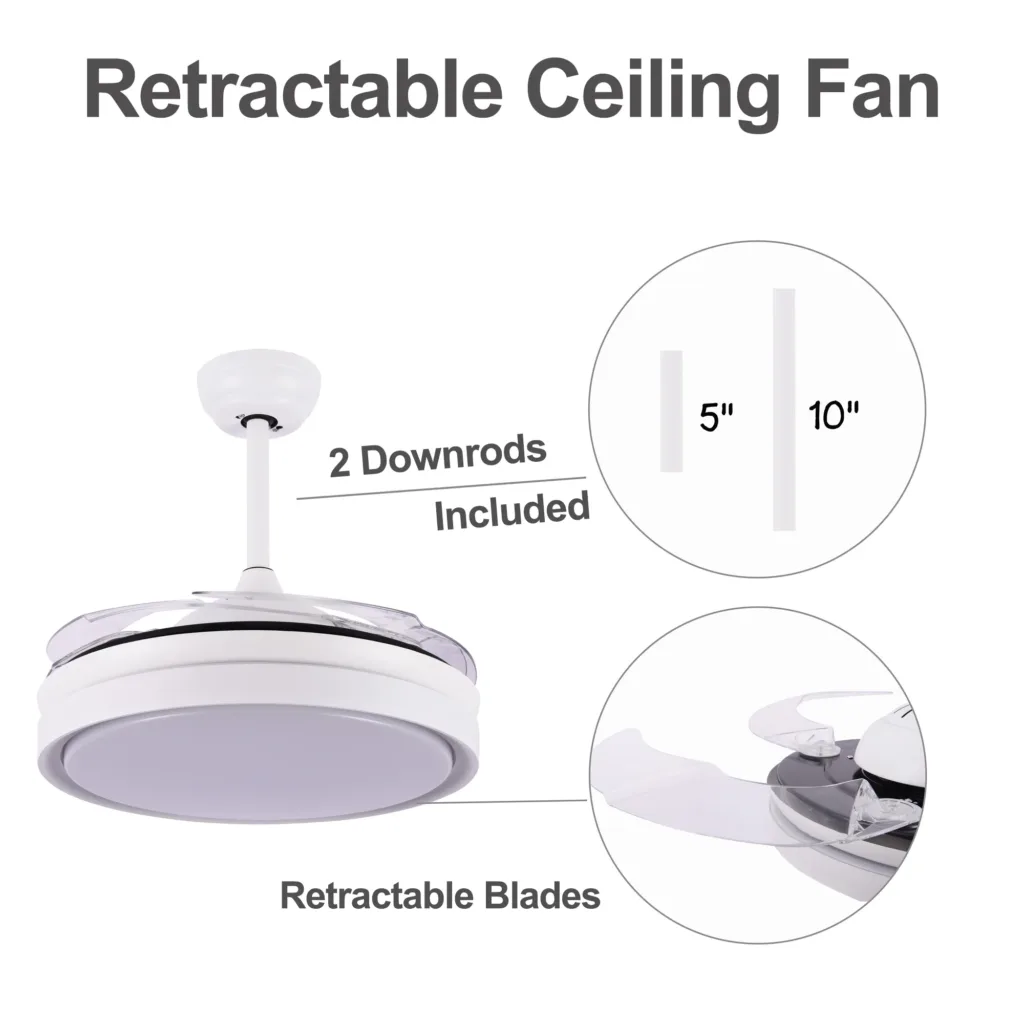
Insert the downrod (suspension pole) into the motor housing’s mounting yoke, and secure it firmly using the provided pins or screws.
Assemble the fan blades: Align each blade with its corresponding blade bracket, and fasten them using the provided washers and screws. Ensure that all blades are aligned at the same angle to maintain proper balance.
Install the Lighting Components
Secure the light fixture housing, install the lampshade and light bulbs (e.g., LED sources), and connect the internal wiring for the lighting unit.
Power-On Testing and Adjustment
Turn on the power to verify that the fan operates smoothly and without any unusual noises.
Test the various lighting modes or settings (e.g., multi-level brightness adjustments or color temperature switching). After 10 minutes of operation, re-check all screws to ensure none have come loose.
Important Precautions
Safety First: Always disconnect the power supply before performing any work. The ground wire must be securely connected to prevent electric shock.
Load-Bearing Capacity: Expansion bolts or wood screws must be anchored into the structural layer; the load-bearing capacity per single point must be ≥ 16 kg.
Accurate Wiring: Wiring color codes may vary between different brands; always refer to the product manual for the correct wiring instructions.
Balance Adjustment: After installing the fan blades, manually rotate the motor gently to confirm there is no collision or wobbling.
Height Requirement: It is recommended that the fan blades be positioned at least 2.3 meters above the floor to avoid contact with obstacles.
If you find self-installation difficult, it is recommended that you contact a professional electrician or schedule an installation service through the brand’s customer support to avoid potential safety hazards.